UK Boarding School Interview Tips for International Students: Your Complete Guide for 2026

Updated: Jun 23
Click the button above and let us help match you with right boarding school and specialist support.
For international students applying to UK boarding schools, the interview is one of the most important and most personal stages of the entire admissions process. It is the moment when the admissions team moves beyond examination results and written applications to meet the person behind the paperwork, and it is an opportunity that, with the right preparation, international students can approach with genuine confidence and genuine excitement. As former UK boarding school educators who have conducted hundreds of boarding school interviews between us, this guide gives you the honest insider perspective on what interviews are really about and how to prepare properly.
Why UK Boarding School Interviews Matter for International Students
UK boarding schools use interviews to understand far more than academic ability. Examination results and school reports tell them what a student has achieved. The interview tells them who that student is, their personality, their intellectual curiosity, their motivation for boarding school, and how they are likely to contribute to the school community.
For international students the interview carries additional significance. It gives the admissions team the opportunity to assess English language proficiency in a natural conversational context, to understand the student's cultural background and how they have engaged with the world beyond their own experience, and to judge whether the student has the personal maturity and genuine enthusiasm that boarding school life requires.
The interview is not designed to catch students out or to create artificial pressure. The best boarding school interviewers are warm, genuinely curious about the person in front of them, and skilled at helping students feel comfortable enough to show their real personality. Going into the interview with that understanding is itself a form of preparation.
What to Expect at a UK Boarding School Interview
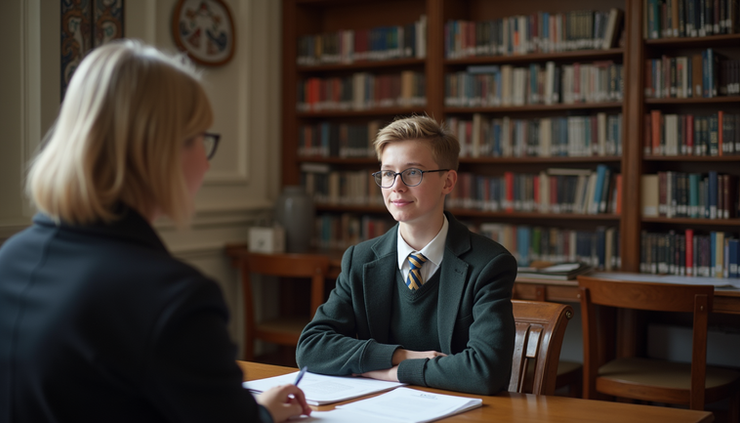
Boarding school interviews typically last between twenty and forty minutes and can take place in person at the school, online via video call, or in some cases through a representative visiting the student's home country. Most interviews involve a member of the admissions team, a subject teacher, a housemaster or housemistress, or in some cases a senior member of the school leadership team.
The format is usually conversational rather than formal. There will be questions about the student's interests, academic background, reasons for applying to this particular school, and plans and ambitions for the future. Some schools include a short written or verbal reasoning task as part of the interview session to assess how a student thinks under light pressure.
The atmosphere at most boarding school interviews is genuinely warm and supportive. Admissions teams know that international students are often nervous and they make deliberate efforts to put them at ease. Students who go in having prepared thoroughly and who allow themselves to engage genuinely with the conversation almost always perform better than those who have rehearsed scripted answers and are trying to reproduce them under pressure.
Common Questions Asked at UK Boarding School Interviews
While every interview is different and the best boarding school interviewers are skilled at following the natural direction of conversation, certain themes come up consistently and students who have thought carefully about these areas in advance are significantly better prepared.
Interviewers will almost always ask why the student wants to attend this particular school and what it is about this school specifically that attracted them. A thoughtful, specific answer that demonstrates genuine research into the school is one of the strongest signals a student can send. A vague or generic answer is one of the weakest.
Questions about academic interests are standard, what subjects does the student enjoy most and why, what have they read or studied recently that genuinely excited them intellectually, what questions do they find themselves thinking about beyond the classroom. These questions are not looking for right answers, they are looking for genuine intellectual engagement and the ability to talk about ideas with real enthusiasm.
Students should also expect questions about their extracurricular interests and achievements, how they have handled challenges or setbacks, how they work in teams, and what they hope to achieve during their time at school and beyond. Questions about how the student feels about living away from home and what they are most looking forward to about boarding life are also common and worth thinking through honestly in advance.
How to Prepare for a UK Boarding School Interview
Thorough preparation makes an enormous difference to interview performance and the most important preparation is not scripting answers but developing genuine familiarity with the school and genuine clarity about the student's own motivations and interests.
Research the school properly before the interview. Read the prospectus, explore the website, look at recent news and achievements, and identify specific things about the school that genuinely appeal. Being able to reference specific programmes, values, traditions or opportunities at the school in conversation with the interviewer demonstrates real interest and real engagement and is consistently one of the things that impresses admissions teams most.
Practice speaking about interests, achievements and ambitions with a parent, family friend or teacher acting as the interviewer. The goal is not to rehearse scripts but to become comfortable speaking confidently and naturally about oneself in English. For international students whose first language is not English this practice is particularly important and should begin well in advance of the interview date.
Prepare two or three thoughtful questions to ask the interviewer. Asking good questions signals genuine interest in the school and in the community the student hopes to join.
Questions about academic support for international students, extracurricular opportunities in areas of genuine interest, or what makes this school particularly distinctive are all good starting points.
Review the application thoroughly before the interview so that anything mentioned in a personal statement or application form can be discussed naturally and with confidence.
What to Wear to a UK Boarding School Interview
Presentation matters at a boarding school interview but the standard is smart and respectful rather than formally corporate. Clean, neat clothing in a smart casual style is entirely appropriate, a shirt or blouse, trousers or a skirt, clean shoes. The aim is to show respect for the school and the occasion without appearing uncomfortable or overdressed.
International students sometimes worry that they need to dress very formally for UK boarding school interviews. They do not. What matters far more than clothing is arriving well prepared, well rested, and genuinely ready to engage.
Top Tips for International Students on Interview Day
Arriving early, or logging on several minutes before the start time for an online interview, gives a student time to compose themselves before the conversation begins and demonstrates the punctuality and organisation that boarding schools value.
Listening carefully to questions before answering is one of the most important skills in any interview. Taking a moment to think before responding is perfectly acceptable and is far better than rushing into an answer that doesn't address what was actually asked. If a question is unclear it is always appropriate and entirely acceptable to ask politely for clarification.
Being honest is always the right approach. Boarding school interviewers are experienced at recognising authentic engagement and manufactured answers in equal measure. A student who is honest about their interests, honest about their concerns about boarding life, and honest about what they hope to achieve will almost always make a stronger impression than one who tries to say what they think the interviewer wants to hear.
What Happens After the Interview?
Following the interview the school will review the full application including the interview notes, school reports, examination results and references. Most schools aim to communicate a decision or next steps within a few weeks of the interview, though the timeline varies between institutions and between different points in the admissions cycle.
If an offer is made it will typically be conditional on achieving certain examination results or on successful completion of further assessments. Families should read any offer carefully and respond promptly within the timeframe specified by the school.
FAQ : UK Boarding School Interview Tips for International Students
How can international students improve their English for the boarding school interview?
The most effective preparation is immersive practice, speaking in English as much as possible in natural conversational contexts rather than formal study alone. Watching English language television and films, reading English language books and news, and having regular conversations in English with a parent, teacher or tutor in the weeks before the interview all help significantly. For students whose English is at an early stage a short intensive conversation course specifically focused on spoken English can make a meaningful difference.
What should a student do if they don't understand a question during the interview?Ask politely for clarification, it is always better to ask than to guess. A student who says "I'm sorry, could you explain what you mean by that?" is demonstrating exactly the kind of honest and thoughtful communication that boarding schools value. Interviewers are always happy to rephrase or clarify.
Should parents attend the boarding school interview with their child?
In almost all cases the interview itself is between the student and the interviewer without parents present. Parents may be invited to a separate tour or meeting with the admissions team on the same day but the interview is the student's opportunity to be seen and heard as an individual. Parents support best by helping with preparation at home rather than by being present in the room.
Can international students do boarding school interviews online?
Yes. Most UK boarding schools now offer online interview options for international students who cannot travel to the school in person. Online interviews follow the same format and carry the same weight as in person interviews and students should prepare for them with the same level of care and thoroughness.
How important is the interview compared to examination results?
Both are important and the best boarding school applications are strong across every element. Examination results demonstrate academic ability but the interview is where personality, motivation and genuine fit with the school community are assessed. A student with excellent results who interviews poorly may lose a place to a student with slightly lower results who interviews with genuine warmth, curiosity and authenticity. Taking the interview seriously is essential.
The boarding school application process can feel daunting but with the right preparation and the right guidance it is a genuinely exciting journey. TIBS is a free matching service founded by former UK boarding school educators who understand the admissions process from the inside. Complete our free matching questionnaire and we will connect your family with the right schools and the right specialist consultant for your needs, completely free of charge.
Click the button above and let us help match you with right boarding school and specialist support.


Comments